AI summary
The article explains why clinic SEO is won locally: patients must attend in person, so Google weighs relevance, distance and prominence when showing results. Drawing on work with regional clinics in Bendigo and Toowoomba, it shows that specific treatment-and-place searches are where regional clinics win, while broad terms are crowded and often bring the wrong patients. It sets out the building blocks of a lasting strategy, from treatment-and-location pages and a well-run Google Business Profile to visible clinical trust, careful paid search and tracking of bookings.
Key takeaways
- Build a dedicated page for each treatment in each place you serve, because specific searches convert best.
- Choose keywords by intent rather than volume, and treat each extra catchment area as its own project.
- Measure calls, forms and bookings, not rankings alone, and keep healthcare advertising rules in mind.
Summary written by AI from this article. Read on for the full detail.
Most businesses can sell to anyone with an internet connection. A clinic can’t. A patient with a concerning mole, a flare-up of eczema or thinning hair needs someone they can reach, trust and see soon.
That one fact shapes everything about how clinic SEO works. It’s why a clinic can be excellent online in the abstract and still invisible to the people who live ten minutes away.
This guide explains why clinic search is so regional, how patients actually look for care, and what a lasting regional strategy looks like. It draws on our work with three regional clinics: a dermatology practice in Bendigo and two clinics in Toowoomba, one in skin cancer and cosmetic care and one in hair restoration.
Why is clinic SEO so regional?
Healthcare is an in-person service
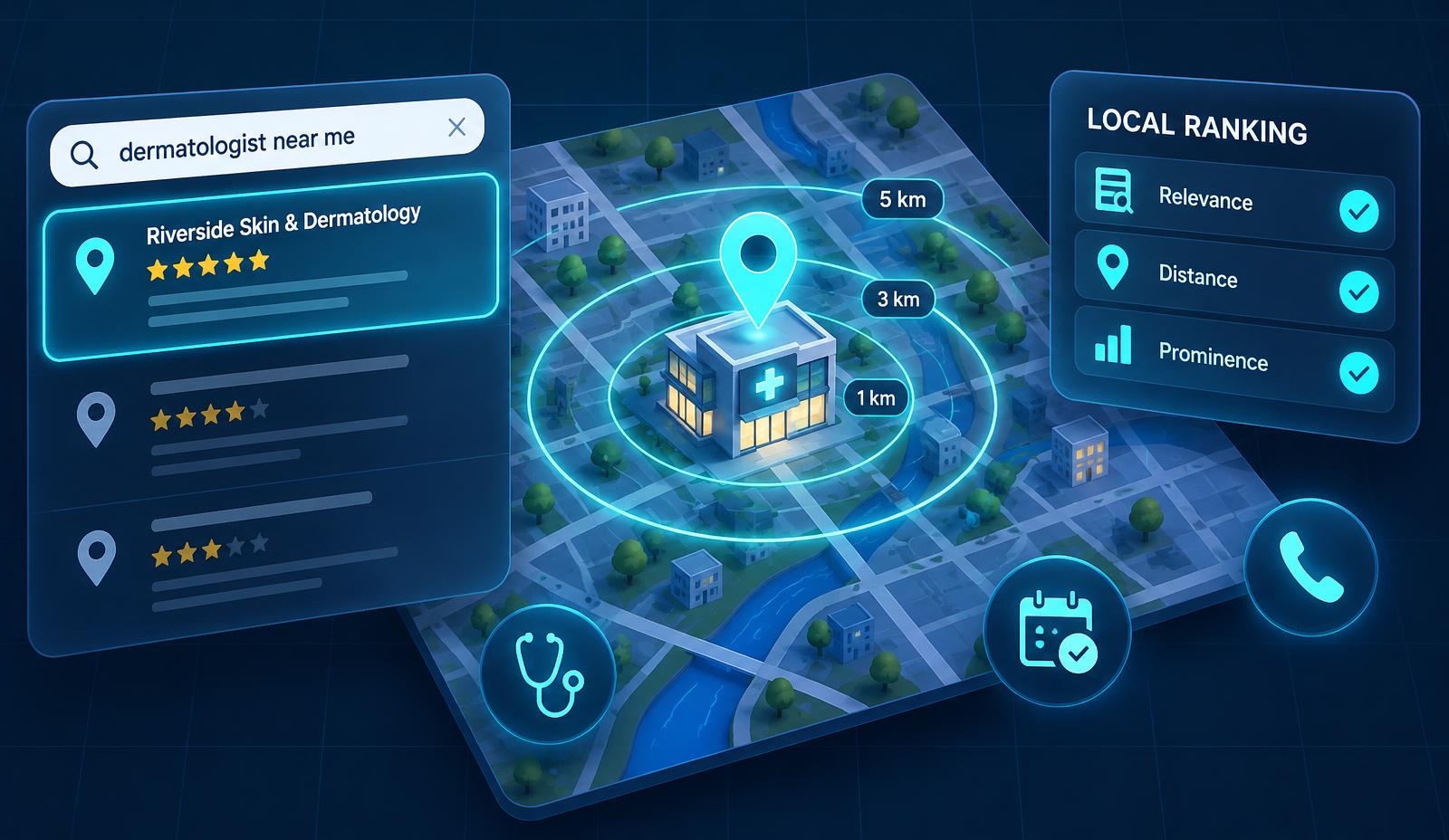
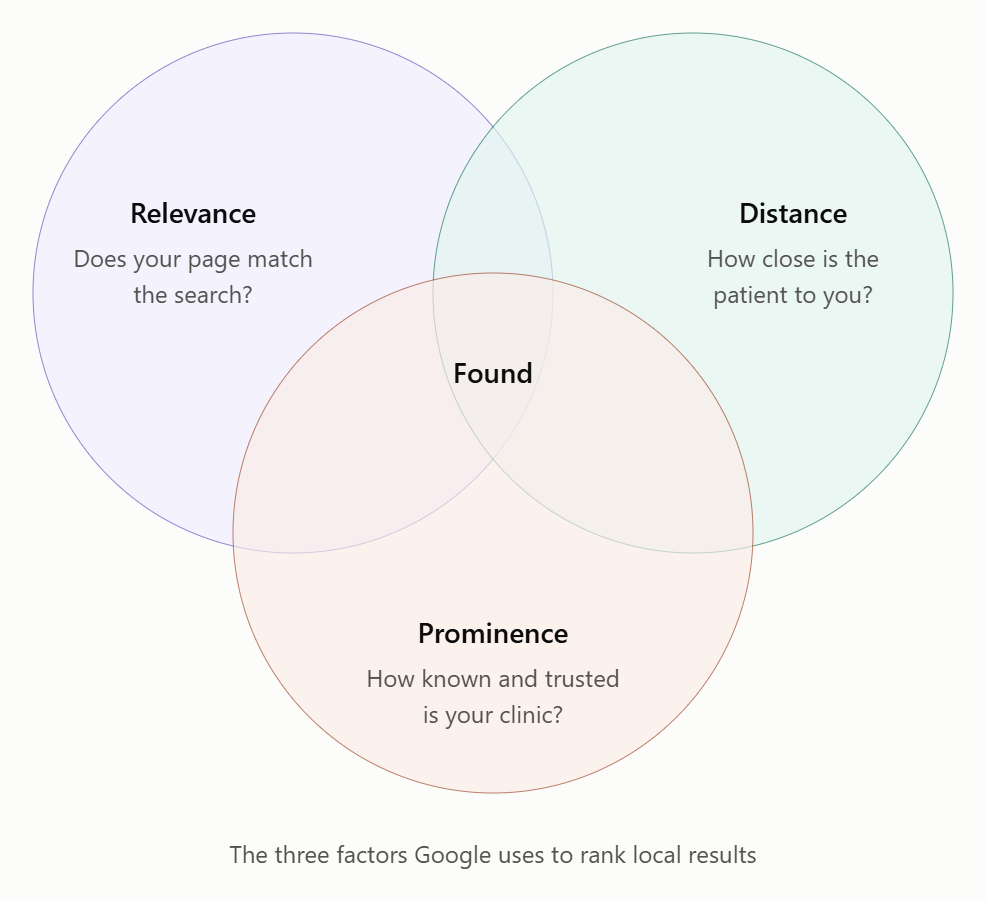
When someone searches “dermatologist” or “skin check,” Google understands there is almost certainly a local need behind it. For local results, Google describes three main factors: relevance (does the business match the search?), distance (how close is it to the searcher?) and prominence (how well-known and trusted is it?).
A clinic can improve relevance and prominence through work. It can’t change its address. Regional SEO is about making relevance and prominence so clear within your catchment that distance works for you, not against you.
Patients research before they book
Healthcare is a considered decision. People look at credentials, the specific treatment, reviews and how easy booking is. A clinic that is hard to find locally, or that doesn’t show clinical trust when someone lands on the site, loses the patient before the first enquiry.
So local visibility and credibility have to work together. Being found without being trusted doesn’t convert, and being trusted without being found doesn’t matter.
Regional markets reward precision
A regional search market is smaller than a capital city’s. Fewer patients means wasted clicks and mismatched traffic cost more. A clinic in Bendigo or Toowoomba doesn’t need millions of impressions. It needs the right few hundred people to find it for the right reason.
What we learned from tracking regional clinics
We monitor keyword positions for our clinic clients, and a few patterns appear again and again. Specific numbers change month to month, but the shape of the pattern doesn’t.
Lesson 1: Specific searches are where regional clinics win
The strongest positions come from highly specific searches that combine a condition or procedure with a place. A dermatology clinic ranks well for particular conditions in its town. A skin cancer clinic ranks well for particular procedures in its town. A hair clinic ranks well for particular techniques in its town.
These patients know what they need and are close to booking. Competition is lower than for generic terms, and a page built around that exact treatment and place is the best answer Google can show.
Takeaway: Build a page for each treatment you offer in each place you serve. A single “Services” page can’t compete with a page that answers one question completely.
Lesson 2: Broad terms are crowded, and often the wrong target
Terms like “skin clinic,” “skin check” or “hair transplant results” are contested by GPs, national chains, directories and publishers. They’re slower to win, and the traffic is often less ready to book.
That doesn’t mean ignoring them. It means building toward them from a base of specific wins, and not judging success by one headline keyword.
Takeaway: Aim first at the searches where you are the most relevant answer. Broad authority follows from specific relevance.
Lesson 3: Distance shapes visibility
One of our clients serves a home town and also wants patients from a major city two hours away. Visibility is consistently strongest at home and gradually weaker the further away the search is. Reaching a second catchment is possible, but it takes dedicated location pages, local signals and patience. It doesn’t happen automatically.
Takeaway: If you serve more than one area, treat each as its own project with its own pages, not one blended page.
Lesson 4: Not ranking can be the right outcome
Some searches a clinic will never, and should never, rank for. A specialist skin cancer clinic doesn’t want to rank for “GP fees” or “book a GP appointment.” It would attract people who can’t be served, and the paid equivalent would burn budget.
Takeaway: Choose keywords by intent, not volume. The goal is patients you can help, not impressions.
Lesson 5: Rankings are a compass, not a destination
Positions move constantly with competitor activity, algorithm updates, personalisation and the searcher’s exact location. Two people in the same suburb can see different results.
Rankings tell you whether you’re heading in the right direction. They don’t tell you whether the business is growing. That is why our clinic projects start with tracking calls, form submissions and booking events, so every decision is tied to appointments.
The building blocks of a lasting regional clinic strategy
1. Treatment-and-location pages. One page per treatment per place, written for patients: who it’s for, what to expect, how to prepare, and what it costs where appropriate.
2. A well-run Google Business Profile. For many local searches, the map results are the first thing a patient sees. Accurate categories, services, hours, photos and a steady flow of genuine reviews matter here.
3. Visible clinical trust. Doctor profiles, qualifications, memberships and educational content answer the question patients are silently asking: can I trust this person?
4. Patient-first content. FAQs, treatment explainers and aftercare guidance earn visibility and trust. Write what you’d tell a patient across the desk.
5. Geo-targeted paid search, done carefully. Paid campaigns work best when built around the places you serve, with negative keywords to remove irrelevant searches. Broad national targeting often attracts people outside your catchment.
6. Conversion and tracking. A site that ranks but doesn’t convert is a missed opportunity. Make booking easy, track what happens, and review which pages and campaigns produce appointments.
A note on compliance
Healthcare advertising in Australia is regulated, including rules from Ahpra and, for some products and services, the TGA. Testimonials, before-and-after images and claims about results need particular care. Good regional SEO works within these rules, and clinical and compliance approval should be part of the process.
See it in practice
We’ve applied this approach to regional clinics in different specialties:
- Central Victoria Dermatology (Bendigo, regional Victoria)
- OJ Clinics (Toowoomba, Queensland)
- Darling Downs Hair Transplant Clinic (Toowoomba and Brisbane)
Each case study sets out the challenge, the work and the outcomes.
A quick self-check for your clinic
- If someone in my suburb searches for my main treatment, do I appear in both the map results and the organic results?
- Do I have a dedicated page for each treatment and each location I serve?
- Can a stranger see my doctors’ credentials within seconds of landing?
- Can I tell how many appointments, not clicks, each channel produced last month?
- Am I chasing keywords that attract patients I can’t serve?
If any answer is “no” or “not sure,” that’s the best place to start.
Want an honest view of how visible your clinic is in your region? Book a Growth Review or request a free audit.
Frequently asked questions
Why is SEO for clinics different from SEO for other businesses?
Patients must attend in person, so searches are heavily local. Trust signals like credentials and reviews also weigh strongly in the decision to book, and healthcare advertising is regulated.
Do regional clinics need a different approach from city clinics?
The fundamentals are the same, but regional clinics often serve a wide catchment with a smaller pool of searches. Precision in treatment, location and ad targeting matters more.
How important is Google Business Profile for clinics?
Very. For many “near me” and suburb-based searches, it’s the first thing patients see. It should be complete, accurate and consistent with your website.
Should my clinic try to rank for broad terms like “skin clinic”?
Eventually, perhaps, but start with specific treatment-and-location searches, where intent is higher and competition is lower. Broad visibility tends to follow.
How long does clinic SEO take?
It depends on your starting point, competition and the work required. Be wary of anyone promising a fixed timeline or a guaranteed ranking.
Is ranking number one the goal?
No. The goal is booked appointments from the right patients. Rankings are a useful indicator, but they don’t replace measuring bookings.
Work with 10xGrowth
Want this applied to your business?
We’ll look at your goals, where enquiries are getting stuck and the first priorities across search, ads and your website.