AI summary
The article explains why trades and home services businesses need a different marketing approach from ecommerce: enquiries start conversations rather than complete sales. It recommends building website trust with local proof, responding quickly and tracking leads through to invoices. Its main advice is to connect traffic, website credibility, follow-up and reporting as one system, measuring booked-job rates and revenue per lead rather than stopping at form submissions.
Key takeaways
- Display trade licences, real job photos, team photos and local reviews to build trust.
- Set up missed-call text-backs and aim to reply to web enquiries within two minutes.
- Connect CRM and offline conversion tracking to measure bookings and revenue, not just enquiries.
Summary written by AI from this article. Read on for the full detail.
If you run a trades or home services business and you’ve ever sat in a meeting with a marketing agency that keeps talking about “conversion rate” like it means one thing, you’ve probably felt a small disconnect you couldn’t quite name. They’re not wrong, exactly. They’re just answering a different question than the one you’re asking.
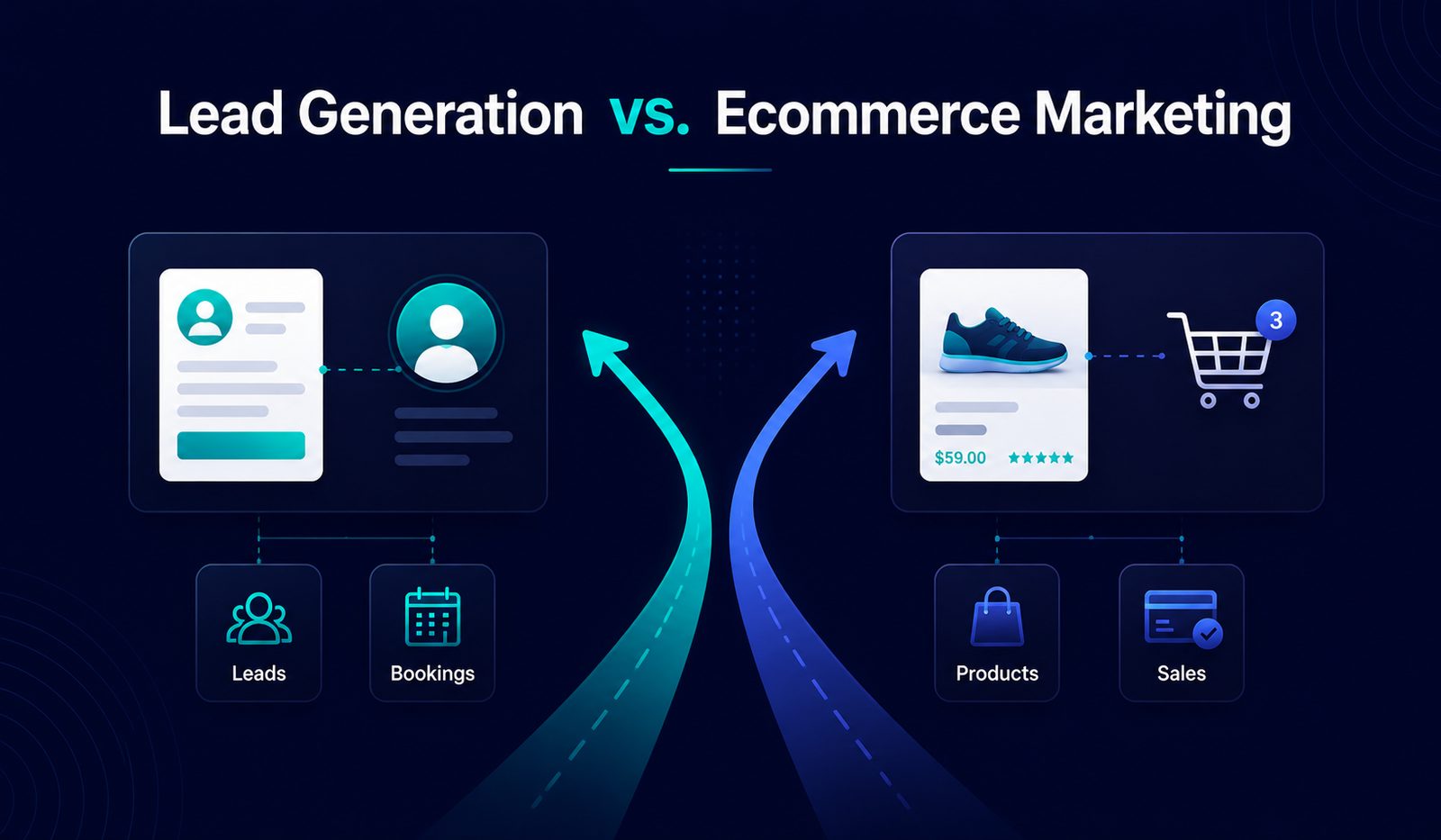
That disconnect has a name. Most digital marketing – the frameworks, the KPIs, the dashboards, the “best practice” – was built for ecommerce. And ecommerce has something service businesses don’t: a finish line you can actually watch.
The Finish Line Problem
An ecommerce store has a checkout. A customer adds a product to a cart, enters their card details, and hits “Pay.” The moment is unambiguous. It’s timestamped, it’s revenue-attributed, and it drops straight into a dashboard. Google Ads knows about it. Meta knows about it. Your analytics platform knows about it. The whole machine of modern digital marketing – pixels, attribution models, ROAS reporting – was built around that one clean, observable event.
A plumber, an electrician, a roofer, a conveyancer, a clinic – none of them have that. What they have instead is a handover: a form submission that becomes a phone call, that becomes a quote, that becomes a booked job, that becomes an invoice. Four or five separate steps, spread across a website, a phone system, a quoting tool and sometimes a paper diary on the ute’s dashboard. Almost none of it is visible to the tracking pixel that fired when the form was submitted.
This isn’t a technicality. It’s the reason so many service businesses feel like their marketing “numbers look fine” while their bank balance doesn’t agree. The tracking stops at the form. The business doesn’t. Everything downstream of that form – the part where money actually changes hands – happens in a system marketing was never built to see.
Get this distinction straight and a lot of confusing agency advice starts making sense, because it explains why the two models are actually optimising for different things entirely.
What a Click Is Actually Buying
In ecommerce, a click is the first step toward a transaction. The customer already knows, more or less, what they want. The job of the website is to remove every possible obstacle between “I want this” and “I’ve paid for this” – fewer form fields, one-click checkout, guest purchase options, saved cards. Every piece of friction you strip out is money you don’t leave on the table.
In lead generation, a click is buying something completely different: permission to have a conversation. Nobody fills out a form for a new roof, a family lawyer, or an NDIS provider the way they buy a t-shirt. They’re handing over their name and number because they’re willing to talk – not because they’ve already decided. The “sale,” such as it is, hasn’t happened. It’s still ahead, and it depends on a human doing something right with that lead in the next few minutes or hours.
This single difference explains almost everything that follows. If a click buys a transaction, your job is to eliminate friction. If a click buys a conversation, your job is to build enough trust that the conversation is worth having – and then to show up for it faster than the business the homeowner also texted five minutes ago.
Trust In, Not Friction Out
Ecommerce marketing spends its energy stripping friction out of the path to purchase. Lead-gen marketing spends its energy building trust into the page, because trust is the actual currency being exchanged.
Think about what a homeowner is really weighing up when they consider filling in an enquiry form for a tradesperson. They’re not comparing product specs. They’re deciding whether to let a stranger into their house, hand over a deposit, and trust that the job will be done properly and safely. That’s a much bigger ask than “add to cart,” and no amount of page-load speed or a slicker checkout button fixes it.
What actually moves the needle here is proof: trade licences and certifications displayed where people can see them, a gallery of real completed jobs rather than stock photography, photos of the actual team who’ll turn up at the door, and a visible local presence – a real Adelaide address, local phone number, local reviews – rather than a generic national-sounding brand. None of this is decoration. It’s the evidence a homeowner uses to answer the only question that matters before they’ll hand over their details: can I trust these people in my home?
This is also where the “versus ecommerce” argument becomes genuinely useful rather than academic. A
A lead-gen website built for a trades or services business needs a completely different information architecture to a Shopify store – credibility signals above the fold instead of product grids, service area pages instead of category pages, and a form that feels like the start of a relationship rather than a checkout field. And for local operators specifically, the trust story is inseparable from the local search story: when someone searches “electrician near me” or “roof repairs Adelaide,” what they click on and what they see once they land there both need to say the same thing – this business is real, local, and good at what it does. That’s exactly the ground covered in
local SEO for trades businesses: the visibility and the credibility have to arrive together, or the click was wasted.
Response Speed Is the Real Conversion Rate
Here’s the part most marketing advice skips entirely, and it’s arguably the single biggest lever a service business has: in lead generation, response speed is your conversion rate.
An ecommerce shopper doesn’t disappear if the confirmation email takes ten minutes. A homeowner with a burst pipe, a family looking for a conveyancer, or a patient trying to book a clinic appointment behaves very differently. They typically don’t fill in one form – they fill in three or four, on three or four competing websites, within the space of an hour. Whoever picks up the phone first, or replies to the text first, usually wins the job. Not because they were cheaper. Not because their website was prettier. Because they were faster.
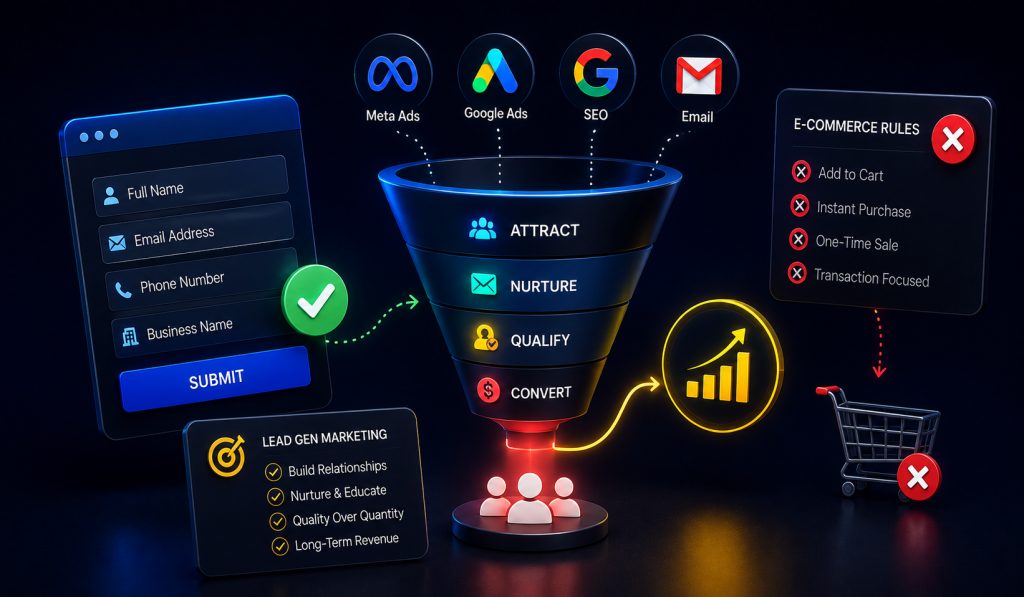
This is where a lot of good marketing gets wasted downstream. A business can generate a strong volume of quality enquiries and still lose most of them to slower competitors, simply because leads sit in an inbox overnight or a missed call never gets a text back. The fix isn’t more traffic. It’s a follow-up system: automatic text-backs when a call is missed, a target of replying to every web enquiry in under two minutes, and an automated nurture sequence for the leads that aren’t ready to book on day one but will be by day five.
This is genuinely the section a plain “ecommerce versus lead gen” explainer never gets to, because it isn’t a marketing tactic – it’s an operations problem that marketing exposes. One recent example: a healthcare clinic group was losing bookings to missed calls and slow follow-up before a CRM, missed-call text-back and nurture sequence were put in place – the kind of fix detailed across
our case studies – which lifted their booking rate by 63% and got lead response time under two minutes across the board. The traffic didn’t change. The follow-up did. The operators who quietly win the most jobs aren’t always the ones spending the most on ads – they’re the ones who answer first.
Measuring the Right Thing
Ecommerce reporting is refreshingly honest: return on ad spend (ROAS) is calculable to the cent, because the platform sees the whole journey from ad click to purchase. Service businesses that try to apply the same yardstick usually end up disappointed, not because their marketing is failing but because they’re measuring the wrong end of the process.
Counting form fills or calls as the finish line tells you almost nothing about whether the business is actually growing, because it stops exactly where the handover begins. Two campaigns can generate the same number of leads at the same cost and produce wildly different revenue, depending on how many of those leads turn into booked jobs and what those jobs are actually worth. The number that matters isn’t cost-per-lead. It’s revenue-per-lead and booked-job rate – and neither of those exists inside a Google Ads or Meta dashboard.
Getting there means connecting the marketing side to the operational side: a CRM that tracks a lead from first enquiry through to invoice, and offline conversion tracking that feeds job outcomes back into the ad platforms so campaigns can actually be optimised toward bookings, not just clicks. It’s a heavier lift than watching a ROAS number tick over, and it’s genuinely worth understanding what your campaigns are optimising toward – the mechanics of that are covered in more detail on our
Google Ads and paid media page. But it’s also the only way a service business gets an honest answer to the question that actually matters: which pounds of marketing spend turned into real, profitable jobs.
It’s a System, Not a Channel
Put all of that together and a pattern emerges. Traffic gets someone to look. The website gets them to trust you enough to hand over their details. The follow-up gets them on the phone before a competitor does. The CRM tells you, honestly, whether any of it turned into a booked job worth having. None of those four things work in isolation – a fast follow-up process on a website nobody trusts is wasted, and a beautifully designed website with no traffic behind it never gets tested at all.
That’s really the whole argument, stripped back to one sentence: ecommerce marketing optimises a transaction, and lead-gen marketing has to run a whole system – traffic, trust, response and measurement – because the “sale” happens somewhere marketing can’t see unless the pieces are built to talk to each other. Treating SEO, the website, the follow-up and the reporting as four separate projects, run by four separate people who never compare notes, is exactly how the handover gets dropped.
If your business is generating enquiries but you’re not confident where they’re actually going once they leave the form, that’s usually not a traffic problem – it’s a systems one, and it’s worth talking through with someone who looks at the whole handover, not just the click.
Work with 10xGrowth
Want this applied to your business?
We’ll look at your goals, where enquiries are getting stuck and the first priorities across search, ads and your website.