AI summary
The article explains how lead generation and ecommerce require different website goals, content, conversion improvements and marketing budgets. Lead generation focuses on qualified enquiries through trust, local search and simple contact options, while ecommerce prioritises purchases through relevant product information and a smooth checkout. Its main advice is to map how customers buy, address friction along that journey and choose tactics suited to the business model rather than a generic checklist.
Key takeaways
- For lead generation, prioritise local SEO, simplify enquiry forms and place trust signals beside contact options.
- For ecommerce, improve product feeds, mobile checkout and shipping cost transparency.
- Map the customer journey before choosing tactics, and give retention attention alongside acquisition.
Summary written by AI from this article. Read on for the full detail.
Table of contents
A friend of mine runs a small landscaping business. Another runs a candle brand that sells entirely online. Both asked me, within the same month, for help with their marketing – and both got frustrated when I gave them different advice.
That’s the thing people miss when they’re new to digital marketing: “getting more customers online” isn’t one strategy. It’s at least two, and they don’t overlap as much as you’d think. A lead generation business and an ecommerce business are solving different problems, at different speeds, with different definitions of success. Treat them the same and you’ll end up optimising for the wrong thing.
Here’s how the two actually differ, and what that means for where you should be spending your time and budget.
Two Different Businesses, Two Different Jobs for Your Website
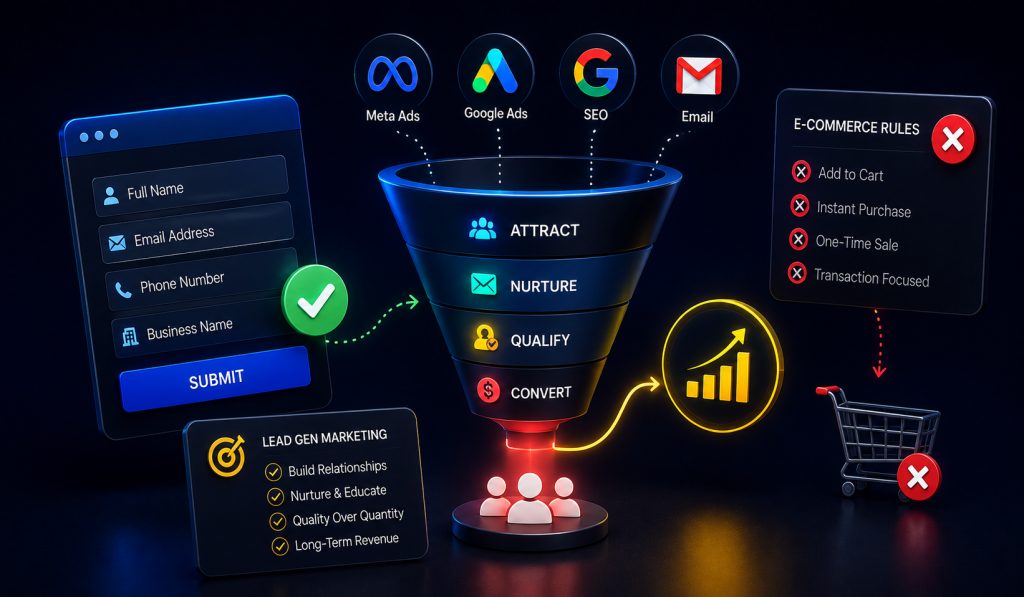
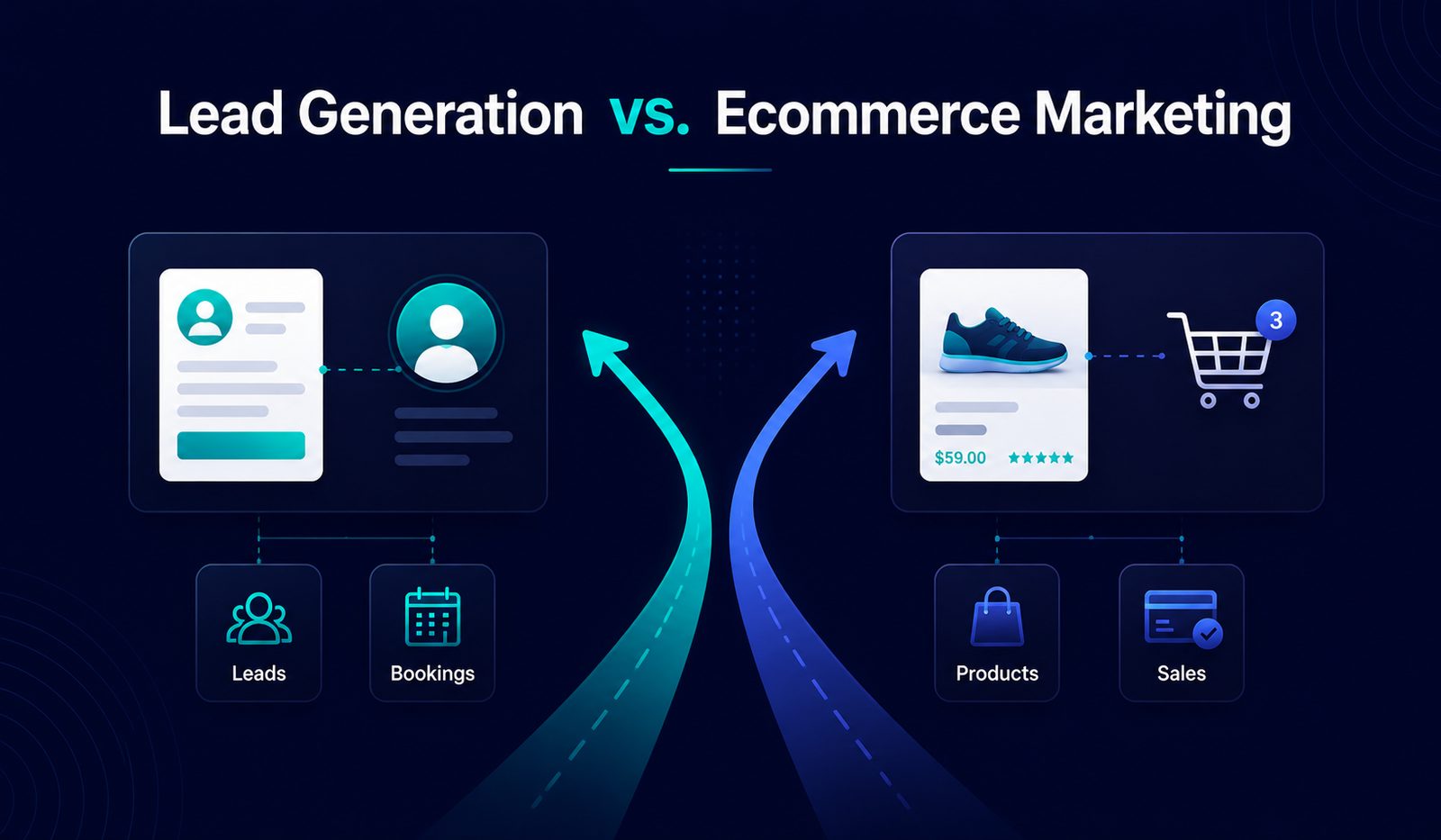
A lead gen website‘s job is to get someone to raise their hand. That’s it. Whether it’s a form fill, a phone call, or a booked consultation, the sale itself almost always happens somewhere else – on a call, in a quote, during an in-person visit. The website is a filter and a first impression, not a cash register.
An ecommerce site has to do the entire job on its own. Nobody’s picking up the phone to close the sale. The product page, the cart, and the checkout flow are the entire relationship between your brand and that customer’s money, often within a single visit. If something’s clunky at any point in that chain, the sale just doesn’t happen – there’s no salesperson to smooth it over.
That single distinction – sale happens later vs. sale happens now – is why almost everything downstream (what you measure, what you write, what you build) ends up looking so different.
| Lead Generation | Ecommerce | |
|---|---|---|
| What “success” looks like | Qualified enquiries, booked calls | Completed purchases, revenue per visit |
| Typical buying window | Days to months | Minutes to a single session |
| Where trust gets built | Reviews, credentials, past work, direct contact | Product reviews, return policy, checkout security cues |
| Main channel driver | Local and organic search, referrals | Paid social, search ads, shopping feeds |
| What kills conversions | A confusing or intimidating enquiry form | A slow page, a clunky checkout, hidden shipping costs |
Why Search Intent Splits the Two Apart
If you’ve spent any time studying SEO, you’ll know search queries generally fall into four buckets: informational, navigational, commercial, and transactional. Lead gen and ecommerce businesses live in different corners of that map.
Someone searching for “best emergency electrician near me” or “how much does a kitchen renovation cost” isn’t ready to hand over money yet – they’re comparing, vetting, trying to figure out who they can trust. That’s commercial and informational territory, and it’s exactly where lead gen businesses should be putting their content. Service pages that actually explain the process, blog posts that answer the questions people ask before they call, case studies, local landing pages – all of it is designed to move someone from “researching” to “willing to talk to a human.”
Ecommerce searches skew transactional much faster. “Buy running shoes size 10” or “wireless earbuds under $100” – the person typing that is close to pulling the trigger. Your job isn’t to build a relationship over three months; it’s to be the obvious, trustworthy, frictionless choice in the next five minutes. That means product titles and descriptions that actually match what people search for, pricing that’s visible early, and reviews sitting right next to the buy button, not buried three clicks away.
Mixing these up is a common mistake. I’ve seen ecommerce brands write long, informational blog content hoping it’ll convert like a service business’s content does – and it just sits there getting traffic that never buys. I’ve also seen tradies and consultants try to run their site like a store, pushing hard for immediate action before anyone’s had a chance to trust them. Neither works, because the intent behind the search was never aligned with the ask. You can see how this plays out in practice across different industries in these client case studies.
Conversion Optimisation Means Different Things Depending on Which Business You Run
Everyone agrees CRO matters. Fewer people agree on what you’re actually optimising for.
For a lead gen site, you’re optimising for fewer, higher-quality actions. There might only be one or two conversion points on the whole site – an enquiry form, a phone number – so each one needs to carry real weight. That usually means:
- Cutting form fields down to what you genuinely need at this stage (you can ask for more later)
- Putting proof – testimonials, before/afters, credentials, response times – right next to the ask, not on a separate page
- Making the phone number and enquiry button impossible to miss, especially on mobile
- Following up fast, because a lead that gets a same-day response converts at a very different rate than one that waits three days
For an ecommerce site, you’re optimising a much longer chain of small decisions, and any one weak link breaks it. Product photography, page load speed, filtering and search, the number of steps in checkout, shipping transparency, and payment options like Apple Pay or Afterpay all sit on that chain. None of them close the sale by themselves, but any one of them can lose it. That’s why ecommerce CRO tends to be more about removing friction than adding persuasion – the persuasion (wanting the product) usually already happened before the person landed on your site.
Where the Budget Should Actually Go
For lead generation businesses, the highest-leverage spend is usually local SEO and a genuinely useful Google Business Profile, backed by content that answers real pre-purchase questions. Paid search can work well too, particularly for high-intent, high-value services, but it tends to be a supplement to organic visibility rather than a replacement for it. Email and remarketing matter here in a specific way: because the decision takes longer, staying visible to someone who visited but didn’t enquire is often what brings them back.
For ecommerce, paid social and shopping ads typically do more heavy lifting, because they’re built to interrupt someone mid-scroll with exactly the product they didn’t know they wanted yet. Product feed quality – accurate titles, categories, and images – has an outsized effect on how far that budget goes. Mobile performance isn’t optional either; the majority of ecommerce browsing now happens on a phone, whether your store runs on Shopify or another platform, so a slow or awkward mobile checkout is a direct revenue leak, not just a UX nitpick.
The one thing both models genuinely share is what happens after the first sale or first job. Acquiring a customer is expensive for everyone. Whether it’s an email flow that brings a shopper back for a second purchase or a check-in call six months after a service was completed, the businesses that grow fastest are usually the ones that treat retention as seriously as they treat acquisition.
Building a Strategy Around How Your Customers Actually Buy
None of this means lead gen and ecommerce marketing are unrelated – the underlying tools (SEO, paid media, email, CRO) show up in both. What changes is how you apply them, because the two models ask something completely different of the person on the other end. One is asking someone to trust you enough to start a conversation. The other is asking someone to complete a transaction before they change their mind.
If you’re building a marketing strategy, start with that distinction rather than a generic checklist. Map out how your actual customers move from “never heard of you” to “became a customer,” and be honest about where the friction and hesitation shows up along the way. The tactics you choose should follow from that journey, not the other way around.
If you’d rather have that map built for you, get in touch with the team at 10xGrowth – we work with both lead gen and ecommerce brands across Australia and build the strategy around your business model, not a template.
Work with 10xGrowth
Want this applied to your business?
We’ll look at your goals, where enquiries are getting stuck and the first priorities across search, ads and your website.