AI summary
The article explains how agencies can organise case studies across their websites to demonstrate relevant experience. It recommends showing a mix of services on the homepage, then matching case studies to each service, location or industry page. Cards should outline the client’s problem, solution and results, linking to detailed pages that support claims with tool screenshots, keyword ranking history and links to the experts involved.
Key takeaways
- Show a curated mix of service case studies on the homepage, linking each to a detailed page.
- Match case study cards to the service, location or industry covered by each landing page.
- Back results with tool screenshots, ranking history and links to the experts who delivered the work.
Summary written by AI from this article. Read on for the full detail.
Table of contents
When a potential client lands on your agency’s website, they are looking for one thing: proof that you can solve their specific problem.
While many agencies dump all their client success stories into a single, cluttered “Portfolio” page, the fastest-growing brands treat case studies as dynamic sales tools. By strategically placing the right case study cards on the right pages, you don’t just satisfy curious visitors—you align perfectly with Google’s algorithmic preference for extreme relevancy and E-E-A-T (Experience, Expertise, Authoritativeness, and Trustworthiness).
Here is the exact blueprint for displaying case studies across your website to maximise conversions, build trust, and dominate search rankings.
1. The Homepage: Showcasing Your Horizon of Work
Your homepage is your digital storefront. Visitors arriving here aren’t always sure which specific service they need yet; they are evaluating your overall capabilities, scope, and track record.
The Strategy: Mix and Match
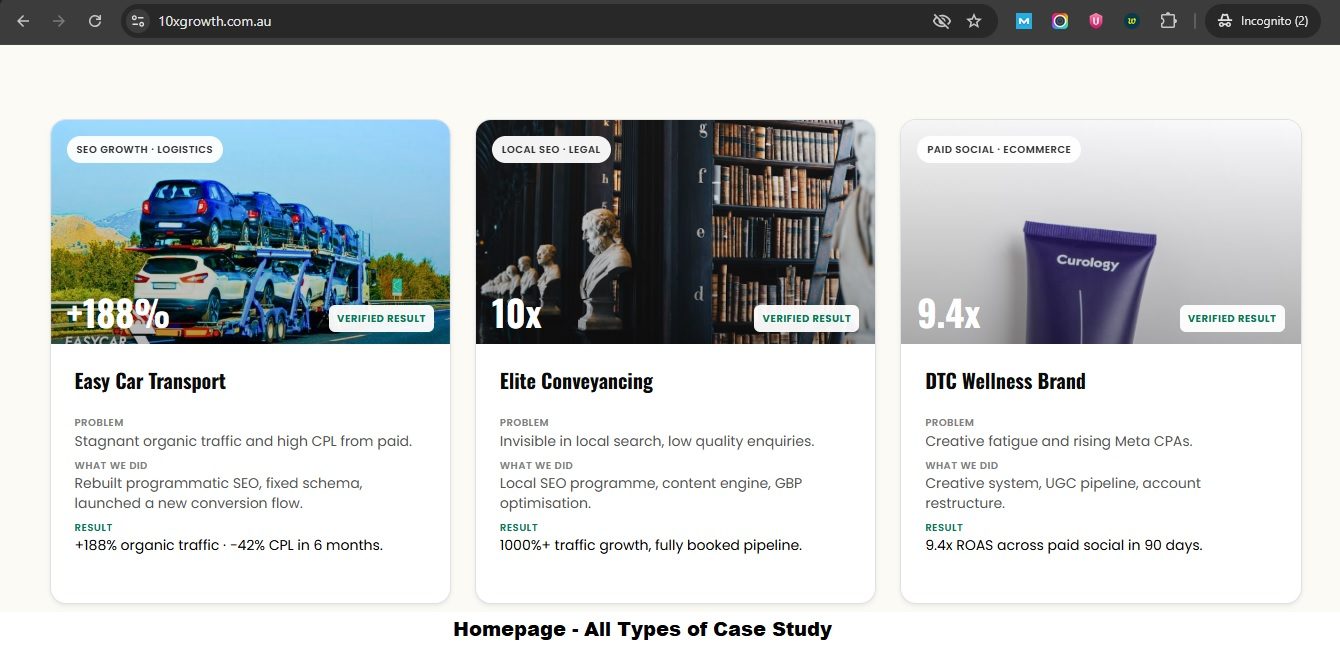
On the homepage, you should display a curated mix of case study cards representing the full spectrum of your services. If you offer SEO, Pay-Per-Click (PPC), social media marketing, and web development, your homepage grid should feature a standout success story from each bucket.
+————————————————————-+
| HOMEPAGE MATRIX |
+——————————+——————————+
| [ Card 1: E-commerce SEO ] | [ Card 2: Local PPC Success ]|
| Result: +140% Organic Traffic| Result: 4x ROI on Ad Spend |
+——————————+——————————+
| [ Card 3: Web Redesign ] | [ Card 4: Lead Gen Campaign ]|
| Result: Double Conv. Rate | Result: 500+ Qualified B2B |
+——————————+——————————+
The Objective
Showcasing a broad horizon of work immediately establishes your agency as a full-service authority. It proves you can handle multifaceted digital ecosystems. Each of these homepage cards must link directly to a dedicated, detailed case study page so interested users can dive deeper into the exact service they care about.
2. Internal Service Pages: Laser-Focused Relevancy
Once a user clicks through to an internal service page—like your dedicated SEO page—the conversation changes. They are no longer browsing; they are investigating a specific solution.
The Strategy: Specific Service Cards
If a prospect is reading about your SEO services, showing them a web design case study is a missed opportunity. On this page, every single case study card must be strictly related to SEO.
To make these cards genuinely compelling, structure them to answer the core narrative of a business challenge:
- The Hurdle / Problem: What was holding the client back? (e.g., stagnant organic traffic, a Google penalty, poor keyword visibility).
- The Strategy / Solution: What specific techniques did you implement?
- The Outcome / Result: What did you achieve, and how long did it take?
3. Taking Relevancy Micro-Vertical: Hyper-Local and Industry-Specific Pages
If you want to truly outperform your competitors, you need to take relevancy a step further by matching the case study to the exact search intent of your landing pages.
Hyper-Local Pages
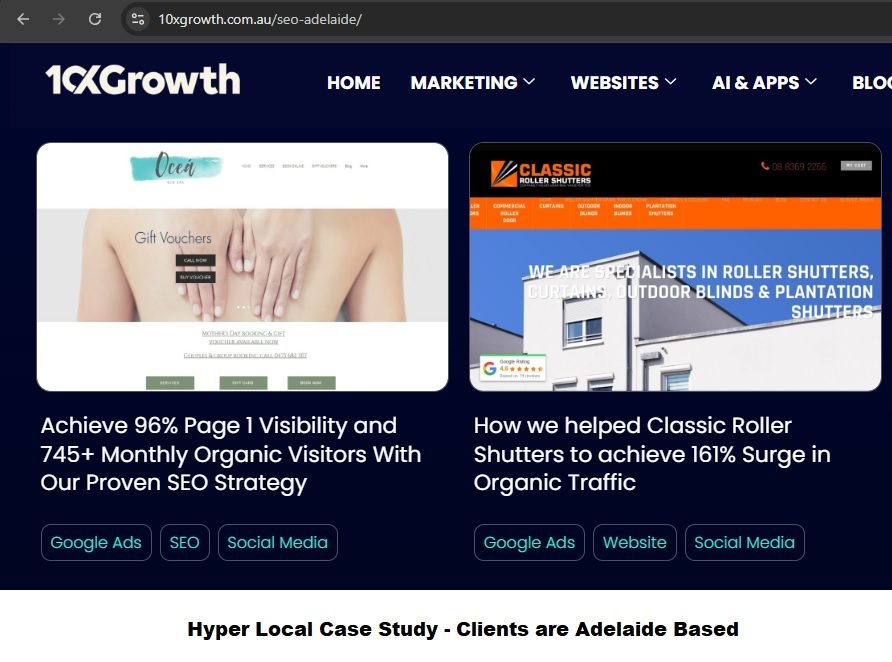
If you run a local landing page targeting a specific geographic area (for example, a page tailored to businesses in a regional hub or specific city, https://10xgrowth.com.au/seo-adelaide/, the case study cards on that page should exclusively feature businesses from that exact area. When a local business owner sees that you’ve already driven massive growth for a neighboring company in their own community, the trust barrier vanishes instantly.
Industry-Specific Pages
The same rule applies to industry verticals. On a niche page like https://10xgrowth.com.au/seo-for-real-estate/ , your case studies must deal solely with property portals, agencies, or developers. A real estate broker doesn’t care how well you ranked a dental clinic; they want to see that you understand property listing optimisation, local map packs, and high-value lead capture.
The Algorithm Secret: Google’s algorithms are designed to mimic human behavior. When a user lands on a highly specific page and finds exactly what they need, their dwell time increases, bounce rates drop, and conversion actions spike. These user signals tell search engines that your page is incredibly valuable, naturally boosting your organic rankings.
4. The Detailed Case Study Page: The Anatomy of Irrefutable Trust
When a visitor clicks a card and arrives at a detailed case study page, they are looking to validate your claims. This is where you must be entirely transparent. For the sake of your reputation and your search rankings, never fake data or make hollow assertions.
True trust is built on hard evidence. To maximise your E-E-A-T signals, ensure every detailed case study includes these three elements:
Real Tool Screenshots
If you claim organic traffic increased by 80%, do not just type the number in a large font. Back it up with a clear, verified screenshot from Google Analytics, Google Search Console, or reputable third-party tracking tools. Show the “before and after” timeline.
Keyword Ranking Proof
If your campaign successfully won high-value search terms, display the historical ranking shifts. Seeing the actual climb from page 5 to the top spot makes your expertise undeniable.
Link to Your Experts
Did a senior technical SEO strategist or a certified Google Ads expert head the campaign? Link the case study to their internal author profile or professional LinkedIn bio. Showing that a real, credentialed human expert executed the work satisfies Google’s strict quality rater guidelines regarding authoritativeness.
Summary: Connect the Dots for Your Audience
By organising your website this way, you create a seamless journey for your visitors:
- Attract them with a broad horizon of success on your homepage.
- Engage them with tailored, context-specific case studies on your service and location landing pages.
- Convert them on the detailed case study page using transparent data, proof of performance, and clear expert attribution.
This layout strategy doesn’t just satisfy an algorithm checklist—it builds a bulletproof user experience that turns casual readers into high-paying clients.
Work with 10xGrowth
Want this applied to your business?
We’ll look at your goals, where enquiries are getting stuck and the first priorities across search, ads and your website.