AI summary
The article explains cost per click (CPC), how it is calculated, and how Google Ads auctions, Quality Score and bidding strategies influence costs. It compares CPC with impression-based and acquisition-based pricing. Its main advice is to assess click costs against customer value rather than chase cheaper traffic, improve ad relevance and landing pages, and audit campaigns to identify wasted spend.
Key takeaways
- Assess CPC against customer value and acquisition costs, not industry averages alone.
- Match ad copy to search intent and improve landing page speed, mobile usability and relevance.
- Audit campaigns for wasted spend and choose pricing models that match campaign goals.
Summary written by AI from this article. Read on for the full detail.
Table of contents
If you have ever run a Google or Facebook ad and found yourself staring at a billing statement wondering where your budget actually went, you are not alone. Cost Per Click, or CPC, is one of those terms that gets thrown around constantly in digital marketing, yet it rarely gets explained in a way that is actually useful to the people spending the money.
So let’s fix that. Here is everything you need to know about CPC, from what it actually means to how you can drive it down without sacrificing results.
The Core Idea: You Pay for Traffic, Not Eyeballs
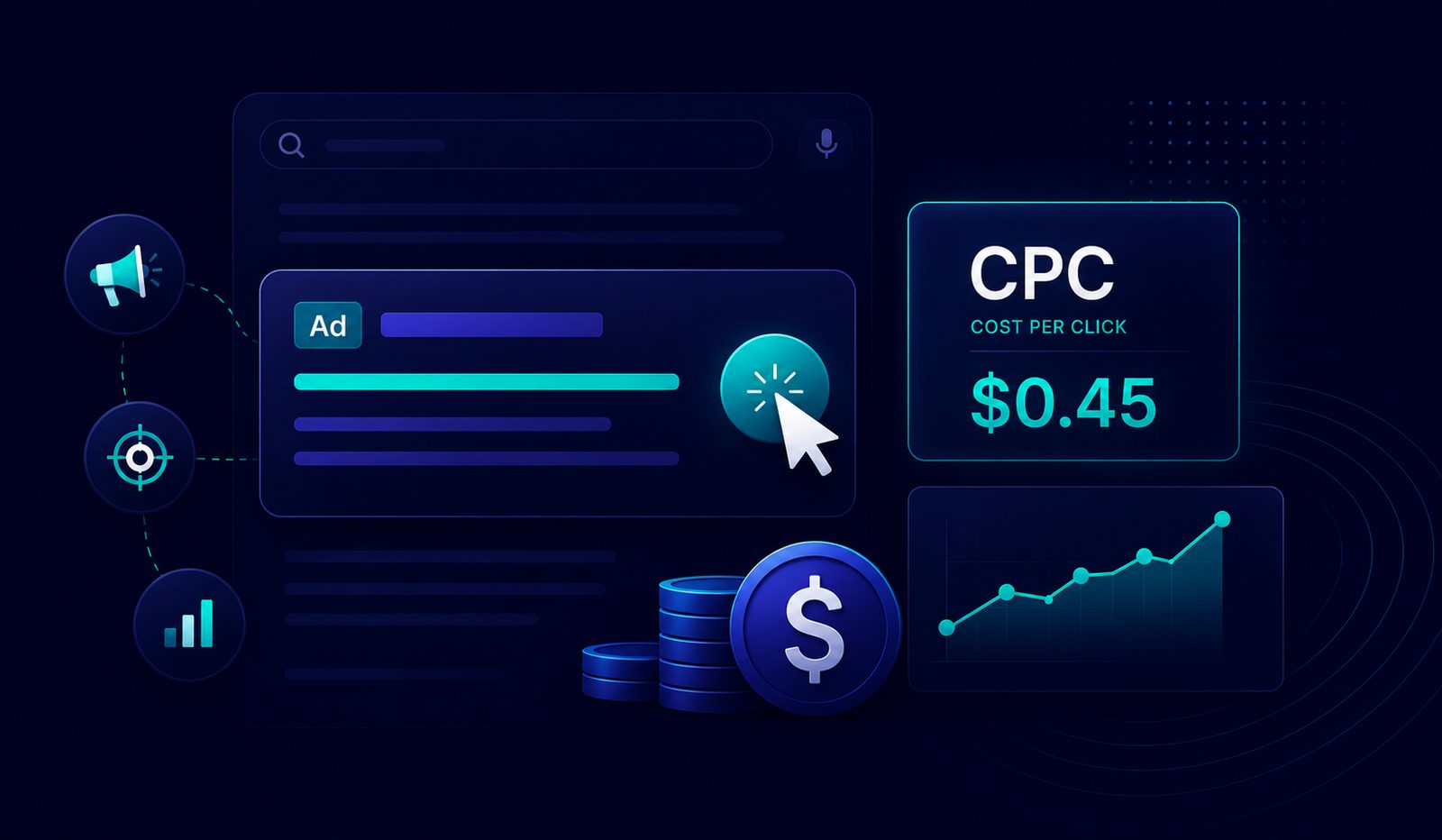
CPC is exactly what it sounds like. It is the price you pay each time someone clicks on one of your pay-per-click ad campaigns, whether that is on Google Search, Microsoft Bing, or a social platform like Facebook or Instagram.
This is a meaningful distinction from other advertising models. With a traditional display buy, you might pay simply for your ad to appear in front of people, whether they engage or not. CPC flips that. You are not paying for exposure. You are paying for a visit.
That makes it a traffic metric at heart. The click gets someone to your site. What happens next, whether they buy, book, or bounce, comes down to your landing page, your offer, and how well you have matched the right ad to the right audience. If you want to understand the broader case for this model, it helps to first understand why paid advertising works for Australian businesses before getting into the cost mechanics.
The Math Is Simple. The Reality Is More Complicated.
On the surface, calculating CPC is about as straightforward as it gets:
Total Spend divided by Total Clicks = Your Average CPC
So if you spent $500 and received 200 clicks, your CPC is $2.50. Clean and simple.
Where things get more interesting is inside the Google Ads auction, because what you actually pay is not just a function of your bid. Google determines your real cost using a formula that looks at your competition:
Closest Competitor’s Ad Rank divided by Your Quality Score, plus one cent
What this means in practice is that you will never pay more than the maximum bid you set. In fact, you will often pay considerably less, because your actual CPC is pegged to what the advertiser just below you would need to pay to beat you, not your own ceiling. This is exactly the kind of nuance that a specialist in Google Ads management uses to find savings inside accounts that look like they are running fine on the surface.
Quality Score: The Number That Actually Controls Your Costs
Inside Google Ads, every ad you run receives a Quality Score between 1 and 10. Think of it as Google’s way of rating how relevant and useful your ad experience is from the moment someone sees your ad to the moment they land on your site.
A higher score directly lowers your CPC. That is not a rough correlation. It is baked into the auction formula.
Google builds this score from four main inputs:
Expected Click-Through Rate looks at how likely people are to click your ad when it appears. If your headline is vague, generic, or fails to address what someone is searching for, this drops. To see how targeted ad structure and intent-matching translate into actual numbers, the real-world results from a hyper-focused Google Ads campaign are worth a look.
Ad Relevance is about alignment between your ad copy and the user’s search intent. If someone types “emergency plumber Melbourne” and your ad talks generally about your plumbing business, you lose relevance points.
Landing Page Experience is where a lot of advertisers bleed money without realising it. Google evaluates whether the page a user lands on after clicking is fast, mobile-friendly, easy to navigate, and actually relevant to what was promised in the ad. A purpose-built lead generation website makes a significant difference here, because it is designed from the ground up around conversion rather than general information.
Historical Performance accounts for your track record on the platform. New accounts start without this data, which is one reason building a clean account structure from the beginning matters more than most people realise.
Improving your Quality Score is one of the highest-leverage things you can do in a Google Ads account, because it lowers your costs while maintaining or improving your position.
What Counts as a Good CPC?
This question comes up constantly, and the honest answer is that it depends on your industry, your margins, and what a converted customer is actually worth to you.
The overall average CPC across all industries sits around $2.69. But that number is almost meaningless on its own, because legal and financial services routinely see averages anywhere from $6 to well over $50 per click. Meanwhile, an e-commerce brand selling mid-range homewares might convert profitably at under $1.
The real question is never “Is this CPC high?” It is “Does this CPC make sense given what I earn from a customer?”
A $40 click that converts into a $5,000 renovation job is an excellent result. A $1.50 click that never produces a single sale is a waste. The metric that matters is whether your cost to acquire a customer sits below the revenue that customer generates. That is the line between a campaign that is working and one that is quietly draining your budget.
Where CPC becomes genuinely problematic is when you are paying an inflated price not because your industry is competitive, but because your Quality Score is poor. That is money you are handing back to the platform for no reason. If you are unsure whether your current campaigns are structured correctly, this guide to finding the right Google Ads specialist in Australia covers what to look for and what to expect.
Bidding Strategies: Control vs. Automation
Google gives advertisers a choice in how they manage their bids, and neither approach is universally better.
Manual CPC puts you in the driver’s seat. You set individual bids at the keyword level, which gives you precise control over how much you are willing to pay for any given click. This approach takes more time and attention, but for advertisers who know their numbers well, it can outperform automated options.
Enhanced CPC (ECPC) is a hybrid model. You still set your base bids, but Google is given permission to adjust them up or down in real time based on signals suggesting a particular user is more or less likely to convert. It is a reasonable starting point for accounts that have enough conversion history for the algorithm to work from.
Both strategies sit within the broader world of PPC campaign management, where the goal is not just to generate clicks but to generate clicks from the right people at the right moment.
When CPC Is Not the Right Model
Not every campaign goal is served by paying per click. Two alternatives worth knowing:
CPM (Cost Per Mille) means you pay for every 1,000 impressions your ad receives, regardless of clicks. This works well when the goal is brand visibility rather than direct response. If you are trying to get a new brand in front of as many people as possible, CPM often delivers better value than CPC, and it is the model that underpins most social media advertising built around awareness rather than conversion.
CPA (Cost Per Acquisition) means you only pay when a specific action is completed, whether that is a purchase, a form submission, or a phone call. It is the most outcome-focused model of the three, though it typically requires a significant volume of existing conversion data before the platform can optimise effectively.
Choosing between CPC, CPM, and CPA comes down to where your campaign sits in the funnel. Building awareness? CPM. Driving site visits and engagement? CPC. Paying only for results? CPA. If you are running Meta campaigns alongside Google and want to understand where spend is going wrong, the breakdown of common Facebook ad mistakes that drain budget is a practical next read.
The Takeaway
CPC is not complicated, but it is easy to misread. The advertisers who get the most out of it are the ones who understand that a low CPC is not always a win, a high CPC is not always a problem, and the Quality Score sitting behind your auction position has more influence over your costs than most people give it credit for.
If you are running paid ads and have not audited your campaigns recently, that is usually the fastest place to find wasted spend. Working with a Google Premier Partner agency in Australia means your account is managed by someone who understands the auction mechanics, not just the dashboard.
Work with 10xGrowth
Want this applied to your business?
We’ll look at your goals, where enquiries are getting stuck and the first priorities across search, ads and your website.